
Hybrid Space Architectures: Multi-Orbit Diversification
Diversification of space capabilities has become a recognized means of increasing the resilience of space systems. Diversification is a step beyond simple distribution, instead delivering capabilities through a number of different ways to avoid common vulnerabilities to one or more threats. There are a number of types of diversification that can accomplish this goal. Highly distributed systems leverage the inherent path diversity for this purpose. But many other architectures involve layered differentiation by orbit, frequency, waveform, or sensing wavelength. Often the architecture is a hybrid one, meaning a joining of multiple smaller sets of satellites to form a single, more diversified whole. For example, the creating orbital diversification through the use of a combination of geosynchronous (GEO) and medium and/or low Earth orbit (MEO, LEO) systems. For a communications system, the users must employ a terminal capable of accessing two or three of these orbital regimes.
The rationale for creating such architectures is that the resilience can be increased as a consequence. The local (or elemental) resilience of each type of satellite could vary, meaning that a LEO satellite might be more resilient to one type of threat while the GEO satellites are more resilient to another. Combined, resilience to the overall threat portfolio is increased. Many of these postulated hybrid architectures do not rely on large numbers of satellites; rather the goal is to affordably increase resilience with the fewest as possible while maintaining the key performance capabilities. Resilience may be further increased by incorporating diversification in other dimensions, such as frequency bands. Again, this adds complexity to the user terminal and requires a cost-performance-resilience trade study to optimize for all three parameters.
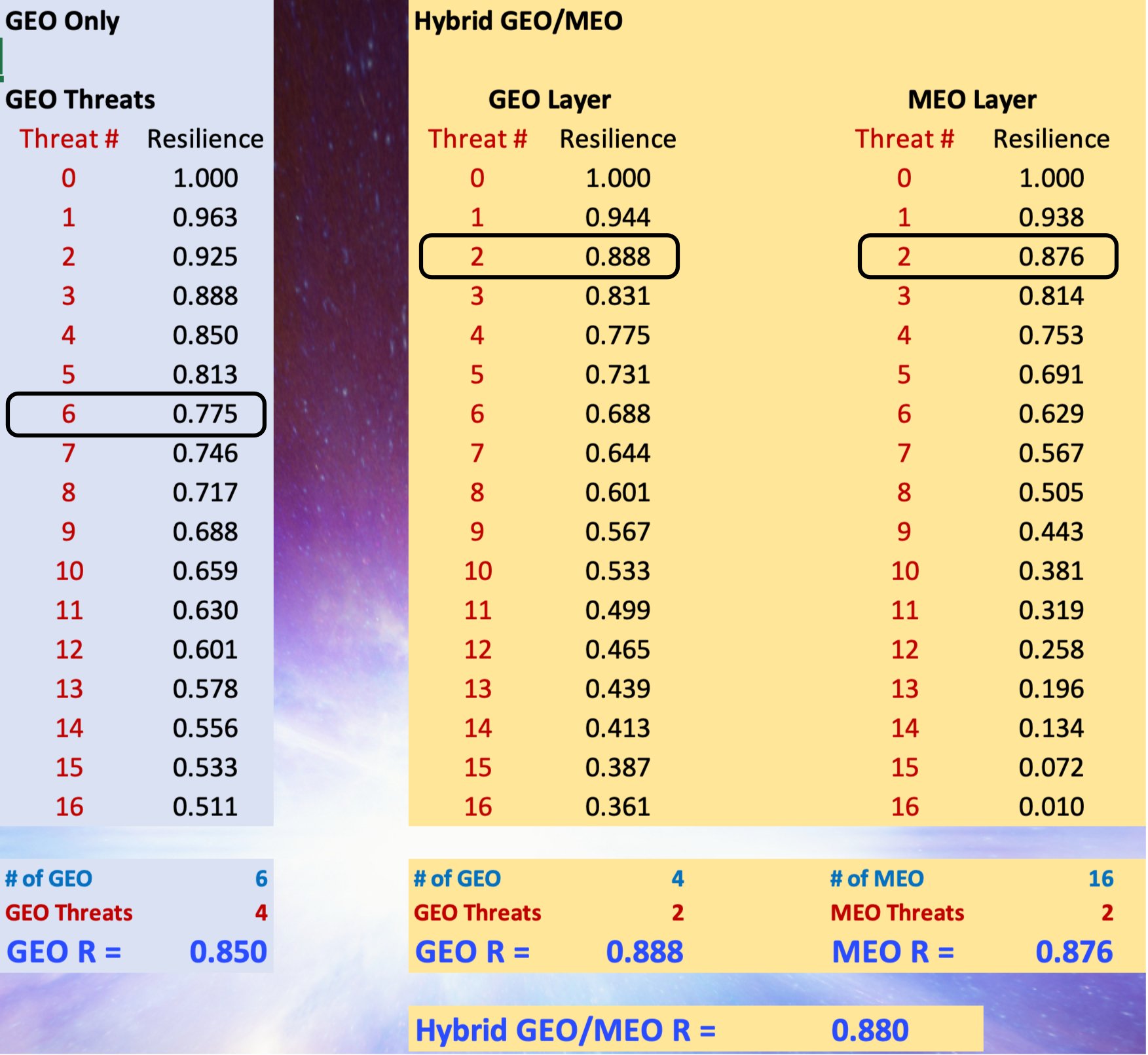
The resilience of the enterprise, or system-of-systems, is the result of the local resilience of each satellite combined with the architectural robustness of the whole. This can easily be modeled at a macro level to aid in the design trade studies. A simple example is a resilience comparison of the estimated resilience for a system of six GEO satellites vs. a hybrid orbital system-of-systems consisting of four GEO satellites plus 16 MEO satellites. For the first solution the total communications capacity (normalized to 1) is uniformly distributed to all six satellites. For the second solution, the MEO satellites are assumed to only provide half of the capacity of the GEOs and then the total capacity is once again uniformly distributed. The result is that the GEOs provide one third of the total capacity and the combined MEOs the remaining two thirds..
An adversary can target up to four satellites, regardless of the architecture, and thus may choose to target GEOs, MEOs, or both. For this example the threat for solution 1 is simply the targeting of four of the six satellites. For the second solution two GEO and two MEO satellites are targeted. The threat effectiveness when targeting the GEO satellite is 0.9 when unmitigated. The threat effectiveness against the LEO satellites is 0.99.
Each type of satellite has a resilience to the threat. If the threat impacts any satellite there is no robustness or recovery and the asset is permanently and irreversibly disabled. The GEO satellites have onboard countermeasures providing a probability of avoidance of the threat of 0.75. This results in an adjusted mitigated threat effectiveness of 0.225, or a probability of avoidance of 0.775, which is the elemental resilience. The smaller LEO satellites are assumed to have no countermeasures and thus the probability of avoidance (and resilience) is 0.01 for each individual satellite.
For a number of of satellites, N, and a threat level of T, and a probability of effectiveness of Pk, the resilience can be found by this equation:

Resilience equation
For the all-GEO architecture the resulting resilience is 0.85. For the hybrid GEO-LEO architecture, the calculation is slightly more complicated, first calculating the resilience of each layer and then combining them. The resilience of the GEO portion of the hybrid layer is 0.888 and the resilience of the MEO portion is 0.876. The combined resilience is found by calculating the total capability loss for the threat scenario, multiplying the fraction of total capability provided by the GEOs (0.333) by the resilience of that layer (0.888) and adding the product of the remaining fractional capability of the MEO layer (0.667) by its resilience (0.876), resulting in a resilience of 0.880.
In this simplified example the hybrid GEO-MEO architecture of 20 satellites provides slightly greater resilience to this threat than the GEO-only six-satellite constellation, though the two are roughly equivalent. Had the adversary targeted only the larger GEO satellites, unaware of the contribution of the MEOs, the overall resilience would jump to 0.925. In addition, the hybrid architecture could be further extended to include a LEO layer as well, further distributing the capability in a similar manner. Of course, cost and performance, including operational flexibility and agility, must always be considered, so this is at best only a partial trade. But this example illustrates how resilience can be allocated and analyzed. A summary table is shown below.